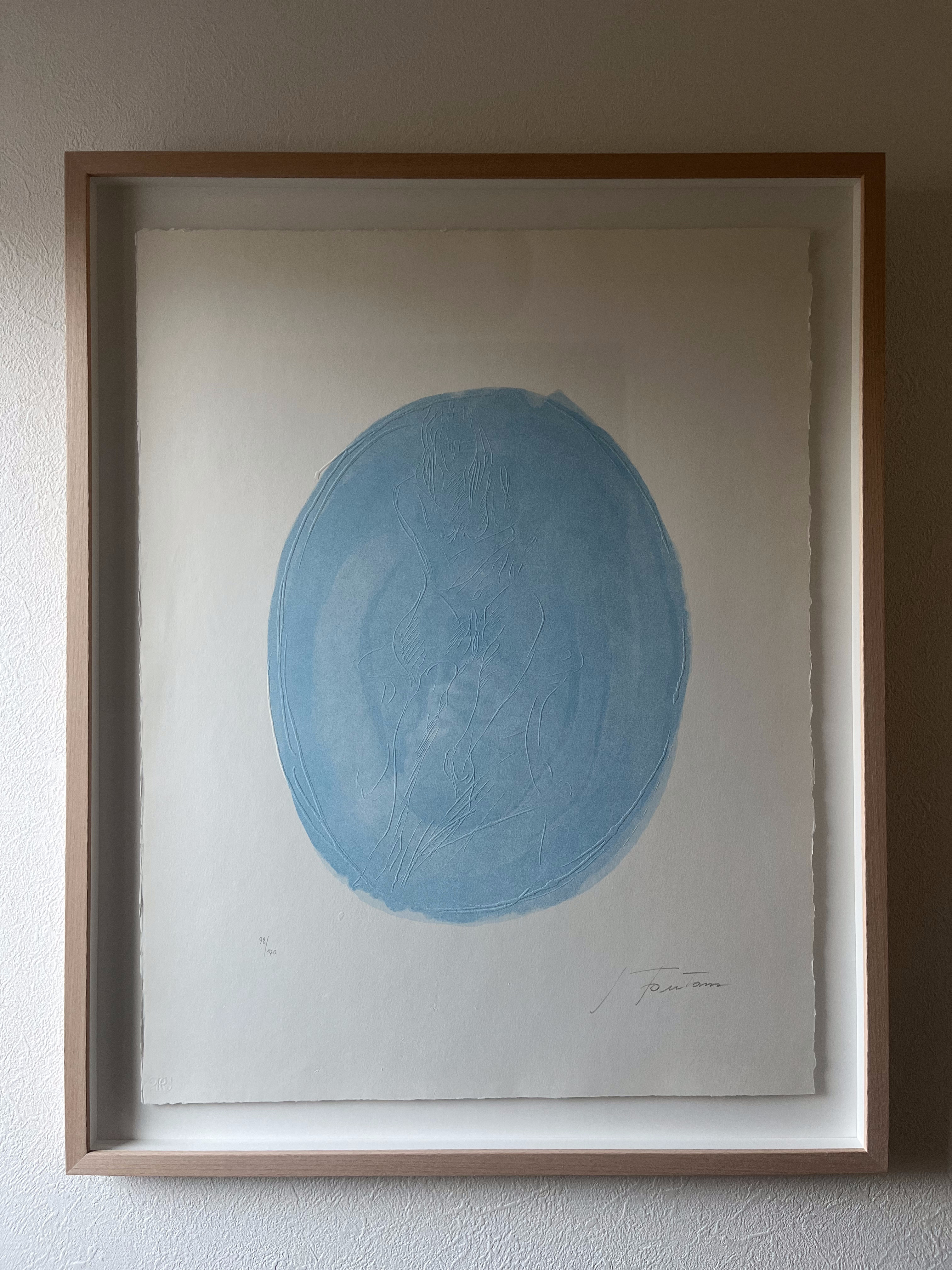
Lucio Fontana
Lucio Fontana (1899–1968) was an Argentine-Italian artist, sculptor, and theorist, and the founder of Spatialism — a movement that sought to transcend the two-dimensional picture plane by exploring the spatial dimensions of art. Born in Rosario, Argentina, to Italian parents, Fontana moved to Milan as a child and trained at the Brera Academy of Fine Arts. After volunteering in World War I, he began his career as a sculptor before developing a radical new artistic language in postwar Milan.
He is best known for his iconic Tagli (Cuts) series (1958–68) — monochrome canvases slashed with a knife — and the Buchi (Holes) series, in which he pierced canvases to open them to physical space. These works, grouped under the title Concetti Spaziali (Spatial Concepts), remain among the most influential gestures in postwar art. In 1946 he co-authored the White Manifesto, laying out his vision for a new art that integrates painting, sculpture, and architecture.
Fontana's work is held in major institutions worldwide, including MoMA, the Guggenheim Museum, the Tate, the Museo Reina Sofía, and the Art Institute of Chicago. He received the Grand Prize for Painting at the Venice Biennale in 1966, two years before his death in Varese, Italy.